

Managing employee attendance is a fundamental responsibility for every organization.
Businesses need reliable records of when employees begin and end their work, while HR teams
need accurate information for payroll, leave management, overtime calculations, and
workforce planning.
For many years, traditional time clocks have been the standard solution. Employees would
clock in and out using physical machines, cards, fingerprint scanners, or other devices
installed at a specific workplace.
But the way people work has changed.
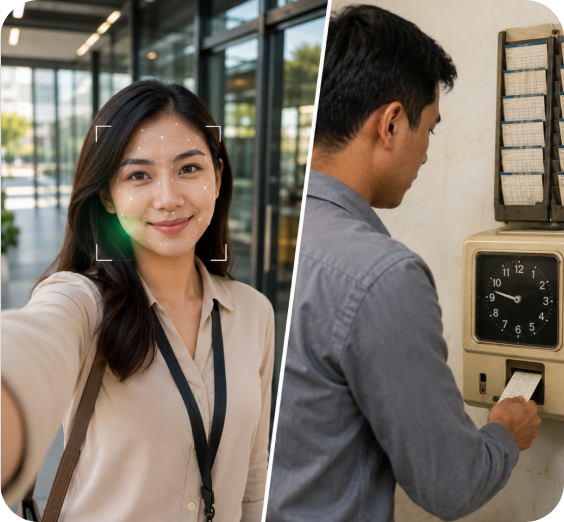
Employees may now work across multiple branches, visit customer locations, travel between project
sites, work remotely, or operate outside a traditional office environment. Because of this,
businesses are increasingly exploring more flexible attendance technologies, including GPS
attendance systems.
GPS attendance allows employees to record attendance through a mobile device while using
location-based technology to verify where the attendance action takes place.
This creates an important question for businesses: Should you continue using traditional time
clocks, or move toward GPS-based attendance?
The answer depends on the organization's workforce, operating environment, security requirements,
and attendance management needs.
MySelfieTime offers a modern approach to employee attendance management, helping businesses move
beyond traditional attendance processes and explore technology-driven ways of recording and managing
employee time.
This guide compares GPS attendance and traditional time clocks, explains their advantages and
limitations, and explores what businesses should consider when choosing an attendance solution.
Understanding Traditional Time Clocks
Traditional time clocks are physical attendance devices installed in a specific workplace.
Employees typically record their attendance by using a physical card, PIN, fingerprint, facial
recognition, or another identification method supported by the device.
The basic concept is simple.
An employee arrives at the workplace, records their time-in, performs their work, and records their
time-out before leaving.
The attendance information is then stored in the system and may be transferred to HR or payroll
software.
Traditional time clocks have remained popular because they are straightforward and familiar.
For organizations where employees work from one central office or facility, a physical attendance
device can still be an effective solution.
However, traditional time clocks have an important limitation: they are tied to a physical location.
That limitation becomes more noticeable when employees are no longer working exclusively from one
location.
What Is GPS Attendance?
GPS attendance uses location-based technology to help verify where an employee records their
attendance.
Instead of requiring an employee to physically approach a clocking machine, the employee can use a
compatible mobile device to record attendance.
Depending on how the system is configured, the organization may establish a designated workplace or
geographic area where employees are allowed to clock in and out.
This can be particularly useful for employees who work outside a traditional office.
Field employees, sales teams, delivery personnel, construction workers, service technicians, and
employees working across different branches may benefit from this type of attendance system.
GPS attendance essentially combines time tracking with location awareness.
Instead of simply knowing that an employee clocked in at 8:00 AM, businesses can have additional
information about where the attendance event took place.
Why Businesses Are Moving Beyond Physical Time Clocks
Traditional time clocks were designed for a workforce that primarily worked in a single physical
location.
Modern businesses can be much more distributed.
Employees may work from home, visit clients, travel between branches, or perform field work
throughout the day.
A physical clock cannot easily follow this type of workforce.
Businesses may need to install multiple attendance devices, manually consolidate records, or develop
alternative attendance procedures.
These workarounds can increase administrative complexity.
GPS attendance offers a different approach by allowing attendance management to become more
location-flexible.
Instead of asking, "Where is the time clock?" businesses can focus on establishing where employees
are authorized to record attendance.
Managing Remote and Hybrid Employees
Remote and hybrid work has changed how businesses think about attendance.
An employee may not be physically present in the company's main office every day.
Traditional time clocks can make this difficult because the employee may have no access to the
physical device.
Businesses may therefore resort to manual attendance forms, messaging applications, spreadsheets, or
other methods.
These approaches can create inconsistent attendance records.
GPS-based attendance can provide a more structured alternative for organizations that need location
information as part of their attendance process.
Depending on company policies and system configuration, employees can record attendance through an
approved mobile device while the organization can receive the relevant attendance information
digitally.
Supporting Field Employees
Field employees present one of the clearest use cases for GPS attendance.
Consider employees who spend most of their working day outside the office.
They may visit customers, inspect locations, perform maintenance, conduct sales visits, or work at
project sites.
Requiring them to return to the office simply to record attendance may be inefficient.
GPS attendance can allow businesses to establish appropriate attendance procedures for employees
working in the field.
The organization can maintain a more centralized attendance record without requiring employees to
physically return to a traditional time clock.
This can save time and make attendance management more aligned with how the workforce actually
operates.

Multiple Branches and Work Locations
Businesses with multiple branches can also benefit from location-based attendance.
A company may operate offices, stores, warehouses, or service locations across different
areas.
With traditional time clocks, each location may require its own attendance device.
Managing these devices can increase hardware costs and administrative work.
GPS attendance can provide a more flexible approach.
Accuracy and Attendance Verification
Accuracy is one of the most important considerations when selecting an attendance system.
Businesses need confidence that attendance records reflect actual working activity.
Traditional time clocks can provide strong physical presence verification because employees
generally need to interact with a device located at the workplace.
However, traditional systems may face other challenges.
For example, businesses need to consider practices such as employees recording attendance for others
or sharing identification methods.
Modern systems can use biometric verification or other authentication methods to reduce certain
risks.
GPS attendance approaches attendance verification from a different angle.
It adds location information to the attendance event.
Depending on the technology, businesses may also combine GPS information with other forms of
identity verification.
This can create a more comprehensive attendance process.
GPS Attendance and Employee Accountability
Attendance systems are not simply about monitoring employees.
They are also about creating clear expectations.
When employees understand when and where they should record attendance, attendance management
becomes easier.
GPS attendance can provide businesses with additional information that helps verify whether
attendance was recorded from an authorized location.
This can be especially useful for organizations with mobile employees.
However, businesses should establish clear policies around GPS attendance.
Employees should understand what location information is collected, when it is collected, and why it
is needed.
Transparency is important when implementing any technology that involves employee information.
The Role of Mobile Technology
One of the biggest advantages of GPS attendance is that it can use devices employees already carry.
Most employees already use smartphones in their daily lives.
A mobile attendance system can therefore reduce the need for businesses to install dedicated
attendance hardware at every location.
This can make deployment easier for organizations with multiple offices or mobile teams.
It also provides greater flexibility as the business changes.
If employees move to a new location, the attendance process does not necessarily require a new
physical clock.
The system can instead be configured around the organization's updated attendance requirements.
Traditional Time Clocks Still Have Their Place
Despite the growth of GPS attendance, traditional time clocks are not obsolete.
They can still be highly effective for organizations where employees work at a single fixed
location.
Factories, warehouses, offices, and other controlled environments may find physical attendance
devices practical.
If every employee begins and ends their workday at the same facility, a traditional time clock can
provide a simple attendance process.
Businesses should therefore avoid choosing technology simply because it is newer.
The right system should match the organization's actual workforce.
The Cost of Attendance Technology
Cost is another factor businesses should consider.
Traditional time clocks typically involve hardware expenses.
Organizations may need to purchase attendance devices, install them, maintain them, and replace them
when they become outdated or damaged.
Businesses with multiple locations may need multiple devices.
GPS attendance can potentially reduce the need for dedicated physical hardware.
However, businesses should consider software subscriptions, mobile device requirements, internet
connectivity, implementation, support, and other costs.
The best approach is to evaluate the total cost of ownership rather than comparing only the initial
purchase price.
Attendance Data and Payroll Integration
Attendance information often feeds directly into payroll.
Late arrivals, overtime, absences, working hours, and other attendance information can
influence employee compensation depending on company policies.
When attendance and payroll systems are disconnected, HR teams may need to manually transfer
information.
This can increase administrative work and create opportunities for errors.
A modern attendance system can help businesses organize attendance information in a format
that can be used for payroll processing.

This can create a more connected HR workflow. For organizations processing payroll for many employees, reducing manual data entry can provide significant efficiency benefits.
Reports and Workforce Insights
Attendance data can provide businesses with more than individual time records.
When collected and organized properly, it can help management understand workforce patterns.
Businesses may be able to review attendance trends, overtime, absences, late arrivals, and other
relevant information.
These insights can help HR teams identify recurring issues and improve workforce planning.
For example, if a particular location consistently experiences attendance problems, management may
investigate whether scheduling or transportation issues are contributing to the situation.
The value of attendance technology therefore extends beyond recording time.
It can provide information that supports better management decisions.
Security and Privacy Considerations
GPS attendance introduces an important consideration: employee privacy.
Location information is sensitive and should be handled responsibly.
Businesses implementing GPS attendance should establish clear policies around location collection
and data access.
Employees should know what information is collected and how it is used.
Organizations should also limit access to attendance and location information to authorized
personnel.
Security measures should be implemented to protect employee information from unauthorized access.
The goal should be to use GPS technology specifically for legitimate attendance and workforce
management purposes rather than unnecessary employee monitoring.
A transparent and responsible approach can help businesses gain the benefits of GPS attendance while
maintaining employee trust.
How MySelfieTime Supports Modern Attendance Management
Businesses looking to modernize their attendance processes can explore solutions such as
MySelfieTime, which is designed around the needs of businesses seeking a more flexible and
technology-driven approach to attendance management.
MySelfieTime can help businesses move away from attendance processes that rely entirely on physical
time clocks and manual records.
By combining digital attendance technology with identity and location-based capabilities, businesses
can create a more convenient way for employees to record attendance while giving HR teams better
visibility into attendance information.
This can be especially valuable for organizations managing employees across different locations.
Rather than forcing every employee into the same physical clocking process, MySelfieTime provides a
more modern approach that can adapt to different workforce environments.
For companies managing office-based, hybrid, remote, or field employees, flexible attendance
technology can make it easier to create consistent attendance procedures.
Making the Transition From Traditional Attendance
Businesses that have used physical time clocks for years may hesitate to change.
However, moving to digital attendance does not necessarily need to happen all at once.
Organizations can begin by identifying their current attendance challenges.
Are employees working in multiple locations?
Are HR teams spending too much time manually correcting attendance records?
Are managers struggling to monitor field employees?
Are attendance records difficult to integrate with payroll?
If the answer to several of these questions is yes, it may be time to consider a more flexible
attendance solution.
A gradual implementation can allow businesses to test the system, train employees, establish
policies, and make adjustments before expanding it across the organization.
Building a More Flexible Attendance Strategy With MySelfieTime
The workplace has changed, and attendance management needs to change with it.
Traditional time clocks remain useful for many fixed-location businesses, but they may not provide
enough flexibility for modern workforces.
GPS attendance offers another approach by combining time records with location-based information.
For businesses with field employees, hybrid teams, remote workers, or multiple locations, this can
provide greater flexibility and visibility.
However, technology should always be implemented with clear policies, employee communication, data
security, and privacy considerations.
MySelfieTime provides businesses with a modern attendance management option that can support
organizations looking for a more flexible alternative to traditional time clocks.
The goal is not simply to replace a physical attendance machine.
It is to create a better attendance process—one that fits the way employees actually work.
As businesses continue to adopt flexible working arrangements and digital HR technology, attendance
management will increasingly become part of a broader connected workforce system.
Whether your business continues with traditional time clocks or moves toward GPS attendance, the
most important consideration is choosing a system that provides accuracy, flexibility, security, and
efficiency.
For businesses ready to modernize, MySelfieTime can help bring attendance management into a more
flexible and digitally connected workplace.


